give the difference between a MAC and an IP address.
explain each section of the IP address header.-
list the different IP address classes with its corresponding detail.
identify the IP version 4 public addresses and IP version 4 private addresses.-
identify the difference between IP version 4 and IP version 6 address.
give the differences between TCP and UDP.
explain what us a subnet and subnet addressing.
explain VLSM and identify its purpose.
An Ip address or Internet Protocol adress is the address assigned to your mobile,printer or computer by the network that uses Internet protocol for communication . Your IP can change with the change in network.IP addresses are divided into classes . A,B,C,D,E mostly we use class B and D
Mac address is your machine address . This address will never change . It is the unique machine address given to your device . Your device will have communication with the local area network or any network using this address . Once you use the network your mac adress is tored in the network table so that network does not have to search your mac address again and again and shortest path towards it will be stored in routing table .
reference: https://www.quora.com/What-is-the-difference-between-an-IP-address-Mac-address-and-gateway-address
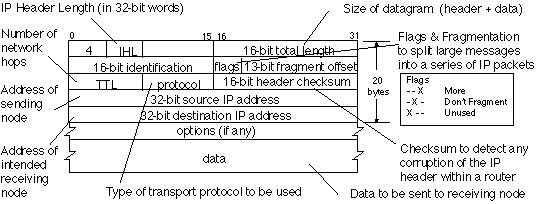
- Version (always set to the value 4 in the current version of IP)
- IP Header Length (number of 32 -bit words forming the header, usually five)
- Type of Service (ToS), now known as Differentiated Services Code Point (DSCP) (usually set to 0, but may indicate particular Quality of Service needs from the network, the DSCP defines the way routers should queue packets while they are waiting to be forwarded).
- Size of Datagram (in bytes, this is the combined length of the header and the data)
- Identification ( 16-bit number which together with the source address uniquely identifies this packet - used during reassembly of fragmented datagrams)
- Flags (a sequence of three flags (one of the 4 bits is unused) used to control whether routers are allowed to fragment a packet (i.e. the Don't Fragment, DF, flag), and to indicate the parts of a packet to the receiver)
- Fragmentation Offset (a byte count from the start of the original sent packet, set by any router which performs IP router fragmentation)
- Time To Live (Number of hops /links which the packet may be routed over, decremented by most routers - used to prevent accidental routing loops)
- Protocol (Service Access Point (SAP) which indicates the type of transport packet being carried (e.g. 1 = ICMP; 2= IGMP; 6 = TCP; 17= UDP).
- Header Checksum (A 1's complement checksum inserted by the sender and updated whenever the packet header is modified by a router - Used to detect processing errors introduced into the packet inside a routeror bridge where the packet is not protected by a link layer cyclic redundancy check. Packets with an invalid checksum are discarded by all nodes in an IP network)
- Source Address (the IP address of the original sender of the packet)
- Destination Address (the IP address of the final destination of the packet)
- Options (not normally used, but, when used, the IP header length will be greater than five 32-bit words to indicate the size of the options field)
reference: Erg.abdn.ac.uk. (2017). Iv4P Packet Header. [online] Available at: http://www.erg.abdn.ac.uk/users/gorry/course/inet-pages/ip-packet.html [Accessed 20 Apr. 2017].
| Class | Start address | Finish address |
| A | 0.0.0.0 | 126.255.255.255 |
| B | 128.0.0.0 | 191.255.255.255 |
| C | 192.0.0.0 | 223.255.255.255 |
| D | 224.0.0.0 | 239.255.255.255 |
| E | 240.0.0.0 | 255.255.255.255 |
reference: Abrams, L., Abrams, L., Abrams, L., Abrams, L., Abrams, L. and Abrams, L. (2017). IP Addresses Explained. [online] BleepingComputer. Available at: https://www.bleepingcomputer.com/tutorials/ip-addresses-explained/ [Accessed 20 Apr. 2017].
IPv4 (Internet Protocol Version 4) is the fourth revision of the Internet Protocol (IP) used to to identify devices on a network through an addressing system. The Internet Protocol is designed for use in interconnected systems of packet-switched computer communication networks IPv4 uses a 32-bit address scheme allowing for a total of 2^32 addresses (just over 4 billion addresses).
IPv6 (Internet Protocol Version 6) is also called IPng (Internet Protocol next generation) and it is the newest version of the Internet Protocol (IP) reviewed in the IETF standards committees to replace the current version of IPv4 (Internet Protocol Version 4). IPv6 addresses are 128-bit IP address written in hexadecimal and separated by colons.
reference: Webopedia.com. (2017). What is The Difference Between IPv6 and IPv4? - Webopedia.com. [online] Available at: http://www.webopedia.com/DidYouKnow/Internet/ipv6_ipv4_difference.html [Accessed 20 Apr. 2017].
| TCP | UDP | |
|---|---|---|
| Acronym for | Transmission Control Protocol | User Datagram Protocol or Universal Datagram Protocol |
| Connection | TCP is a connection-oriented protocol. | UDP is a connectionless protocol. |
| Function | As a message makes its way across the internet from one computer to another. This is connection based. | UDP is also a protocol used in message transport or transfer. This is not connection based which means that one program can send a load of packets to another and that would be the end of the relationship. |
| Usage | TCP is suited for applications that require high reliability, and transmission time is relatively less critical. | UDP is suitable for applications that need fast, efficient transmission, such as games. UDP's stateless nature is also useful for servers that answer small queries from huge numbers of clients. |
| Use by other protocols | HTTP, HTTPs, FTP, SMTP, Telnet | DNS, DHCP, TFTP, SNMP, RIP, VOIP. |
| Ordering of data packets | TCP rearranges data packets in the order specified. | UDP has no inherent order as all packets are independent of each other. If ordering is required, it has to be managed by the application layer. |
| Speed of transfer | The speed for TCP is slower than UDP. | UDP is faster because error recovery is not attempted. It is a "best effort" protocol. |
| Reliability | There is absolute guarantee that the data transferred remains intact and arrives in the same order in which it was sent. | There is no guarantee that the messages or packets sent would reach at all. |
| Header Size | TCP header size is 20 bytes | UDP Header size is 8 bytes. |
| Common Header Fields | Source port, Destination port, Check Sum | Source port, Destination port, Check Sum |
| Streaming of data | Data is read as a byte stream, no distinguishing indications are transmitted to signal message (segment) boundaries. | Packets are sent individually and are checked for integrity only if they arrive. Packets have definite boundaries which are honored upon receipt, meaning a read operation at the receiver socket will yield an entire message as it was originally sent. |
| Weight | TCP is heavy-weight. TCP requires three packets to set up a socket connection, before any user data can be sent. TCP handles reliability and congestion control. | UDP is lightweight. There is no ordering of messages, no tracking connections, etc. It is a small transport layer designed on top of IP. |
| Data Flow Control | TCP does Flow Control. TCP requires three packets to set up a socket connection, before any user data can be sent. TCP handles reliability and congestion control. | UDP does not have an option for flow control |
| Error Checking | TCP does error checking and error recovery. Erroneous packets are retransmitted from the source to the destination. | UDP does error checking but simply discards erroneous packets. Error recovery is not attempted. |
A subnet (short for "subnetwork") is an identifiably separate part of an organization's network. Typically, a subnet may represent all the machines at one geographic location, in one building, or on the same local area network (LAN). Having an organization's network divided into subnets allows it to be connected to the Internet with a single shared network address. Without subnets, an organization could get multiple connections to the Internet, one for each of its physically separate subnetworks,
Subnet addressing allows us to split one IP network address into smaller multiple physical networks known as subnetworks. Some of the node numbers are used as a subnet number instead. A Class B address gives us 16 bits of node numbers translating to 64,000 nodes. Most organizations do not use 64,000 nodes, so there are free bits that can be reassigned. Subnet addressing makes use of those bits that are free,
reference: Documentation.netgear.com. (2017). Subnet Addressing. [online] Available at: http://documentation.netgear.com/reference/nld/tcpip/TCPIPBasics-3-08.html [Accessed 20 Apr. 2017].
Variable Length Subnet Mask, abbreviated as VLSM, is a means to specify a different subnet mask for the same network number on different subnets. With VLSM, a network administrator can use a long mask on networks with few hosts and a short mask on subnets with many hosts. To use VLSM, the routing protocol must support it.
reference: Webopedia.com. (2017). What is variable length subnet mask? Webopedia Definition. [online] Available at: http://www.webopedia.com/TERM/V/variable_length_subnet_mask.html [Accessed 20 Apr. 2017].


Tiada ulasan:
Catat Ulasan